


Tetra Drip Development Story
- 1月6日
- 読了時間: 3分
更新日:1月15日
by Shingo Numata
With the arrival of the so‑called third wave, high‑quality coffee became easier to find year by year in the late 2000s. I was one of the many who became captivated by specialty coffee.
In 2009, my wife and I planned a hiking trip to Nepal. Before the trip, we talked about how nice it would be to drink coffee while looking out over the mountains, so we started researching gear. Compact, packable outdoor coffee drippers did exist at the time, but since we were living in China for work back then, getting our hands on well‑designed outdoor equipment wasn’t easy. So, I ended up making my own dripper: cutting up a 1.5‑liter plastic bottle, heating and shaping it to fit a conical paper filter. I didn’t know the term at the time, but that was my first experience with MYOG.

The trek in Nepal was unforgettable.
Sipping coffee brewed with my homemade dripper while gazing at the majestic Himalayas was truly exceptional.
Looking back, that moment was the origin of it all.

The following year, after returning to Japan, I began seriously researching coffee drippers.
I bought and tested nearly every dripper I could get my hands on. Solid drippers used in cafés and at home brewed great coffee, but they were heavy and bulky to carry around. Outdoor models, on the other hand, prioritized being lightweight and compact, which made them unstable, lacking in rigidity, and difficult to use. Most of them seemed designed with the attitude that as long as they could extract coffee, that was good enough.

At that point, there simply wasn’t a portable coffee dripper anywhere in the world that I felt satisfied with.
It was a small thing, but I remember feeling as though I had found a problem that I myself needed to solve.
It was exciting.
From there, I threw myself into developing a coffee dripper. While exploring different structural ideas, I looked at the designs of the VARGO Hexagon Stove and Snow Peak’s fire‑grill‑style dripper. Seeing those, I realized that a polyhedral structure made from flat plates could accommodate the conical paper filters that had already become the standard at the time, and that if the plates could be disassembled, the whole thing might pack down flat like a card. In this case, increasing the number of plates brings the shape closer to a cone. However, once a structure has four or more faces, the angles between the panels cannot be fixed. Eliminating this lack of fixed angles requires adding extra mechanisms—such as stoppers—which complicate the structure and compromises portability. I spent some time searching for a solution to this structural limitation and eventually arrived at the idea of reducing the number of faces to three. A triangular pyramid made of three panels naturally locks the faces together, fixing the angles. In effect, it could be a simple, flat set of plates that, when assembled, forms a dripper with excellent stability and rigidity.

I started by cutting thick paper to create the shape, and from there I searched online for a factory that could laser‑cut metal and had them make samples, which I tested myself.
After several rounds of prototyping, the basic design took its final form in 2014—five years after returning from that trip to Nepal.

In 2015, I launched a crowdfunding campaign to support the debut of this dripper, which I named “Tetra Drip.” The project received an incredible amount of support from so many people. The funds we raised were, of course, a tremendous help, but even more encouraging were the positive reactions to the product itself. Having just left my previous job, those messages truly gave me courage. I am deeply grateful. Thank you so much.
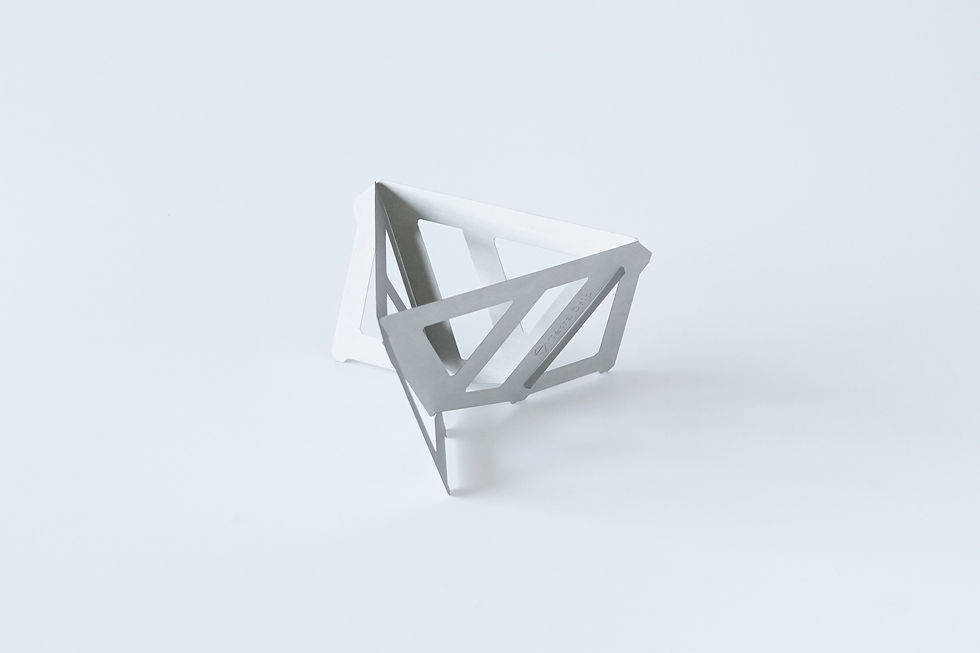
And so, Tetra Drip was officially launched in 2016. Since then, there have been a few minor adjustments, but because its design is already as minimal as it can be—nothing left to take away—the core design remains unchanged even today.
It has been taken to the sea, to the mountains, and to places all over the world, using it to brew delicious coffee while enjoying beautiful scenery. As the person who made it, I couldn’t be happier.

